
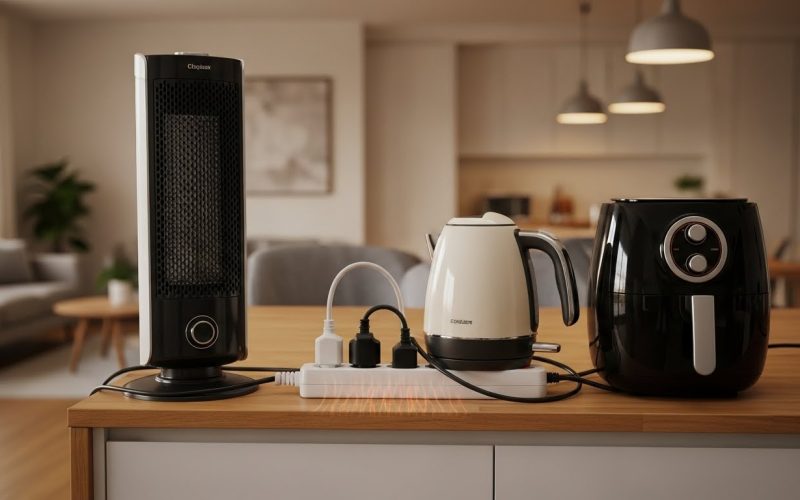
You plug your devices into a power strip every day without giving it a second thought. But here’s something that might change that: electrical faults cause around 40% of residential fires in Australia each year.
Many of these fires start because people don’t realise which appliances can safely use a power strip and which ones can’t.
Why Power Draw Matters
Power strips typically handle 10-15 amps (2,400-3,600 watts) max. But you shouldn’t load them to capacity — keeping usage around 80% (1,920-2,880 watts) prevents overheating.
The problem? A single high-wattage appliance can exceed this limit, especially when combined with other devices on the same strip.
5 Items You Should Never Plug Into a Power Strip
1. Space Heaters (1,500-2,400W)
Space heaters are fire hazards waiting to happen on a power strip. They draw 1,500 watts or more, often exceeding the safe capacity of a power strip on their own.
2. Microwaves (1,000-1,800W)
Your microwave pulls between 1,000-1,800 watts when heating food. That’s massive power draw in short bursts, creating heat buildup in the power strip’s wiring. Even a brief 2-minute heating cycle can stress a power strip beyond its design limits.
3. Refrigerators (600-800W Running)
Fridges need constant power and have high startup currents — sometimes 2-3 times their running wattage. This surge can trip circuit breakers or damage power strips over time. They’re also permanent appliances that should always connect directly to wall outlets, never temporary solutions like power strips.
4. Air Fryers (1,400-1,800W)
These trendy kitchen appliances are basically mini ovens. They draw significant power to heat their elements quickly, putting strain on power strip circuits. Add a toaster or kettle to the same strip? You’re asking for trouble.
5. Electric Kettles (1,500-2,400W)
Boiling water requires serious energy. Electric kettles pull anywhere from 1,500-2,400 watts for the few minutes they run — but that brief, intense power draw generates heat that can melt power strip components.
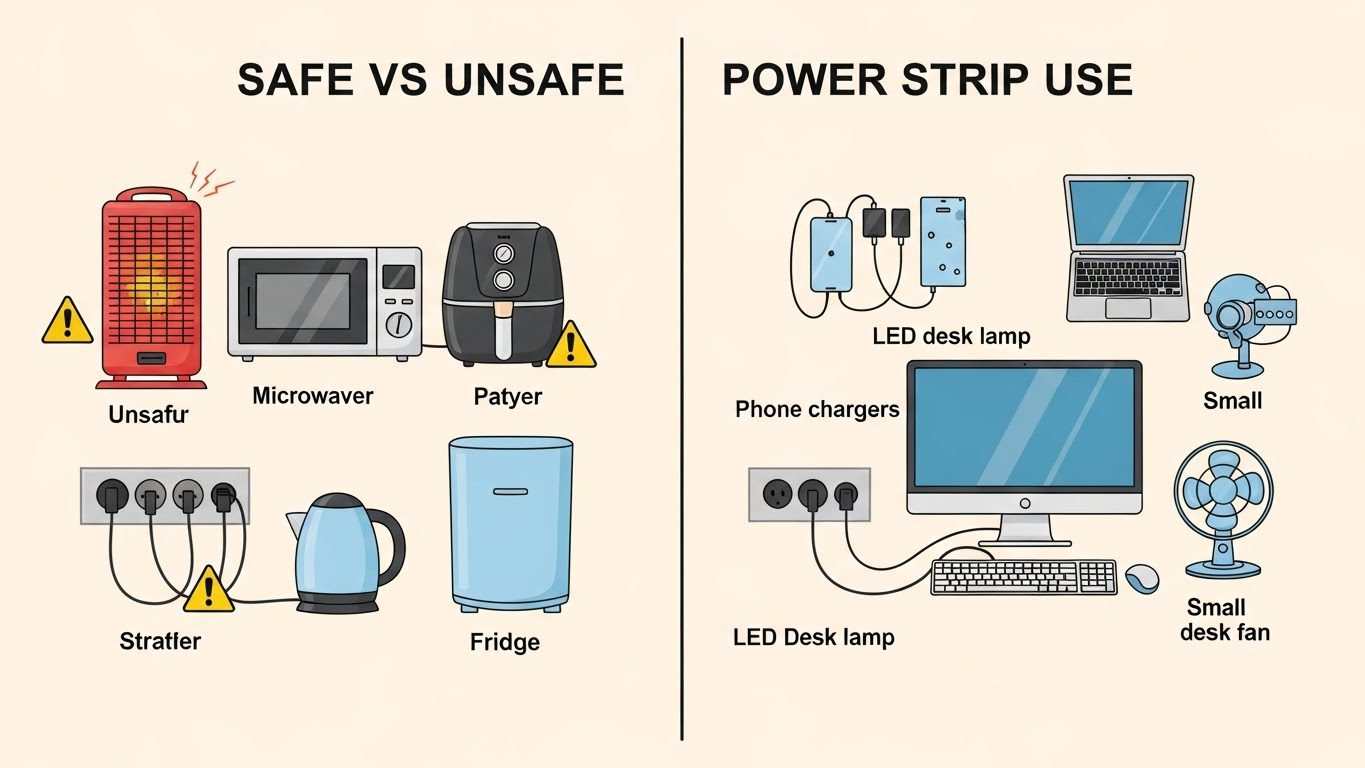
5 Items Safe for Power Strips
1. Laptops (45-100W)
Your laptop charger draws 45-100 watts — a fraction of what high-power appliances need. Even running multiple laptops on one power strip stays well within safe limits. This makes power strips perfect for home offices where multiple devices need to be powered simultaneously.
2. LED Desk Lamps (5-20W)
Modern LED lamps are incredibly efficient. A typical LED desk lamp uses 5-20 watts, meaning you could run 20+ lamps on a single power strip before approaching capacity limits.
3. Phone Chargers (5-20W)
Smartphone and tablet chargers typically draw minimal power, usually between 5 and 20 watts, depending on their fast-charging capability. You can safely charge multiple phones from one power strip without concern.
4. Computer Monitors (20-60W)
Even large desktop monitors only consume 20-60 watts. A dual or triple monitor setup will use around 120-180 watts combined — perfectly safe for power strip use.
5. Small Desk Fans (15-50W)
Personal desk fans are low-power devices, typically drawing 15-50 watts. They’re designed for continuous use and won’t stress your power strip’s capacity.
How to Tell If You’re Overloading Your Power Strip
Check for these warning signs:
- The power strip feels warm or hot to touch
- Burning plastic smell (this is urgent — unplug immediately)
- Flickering lights when you turn on appliances
- Circuit breaker trips repeatedly
- Discolouration or melting around plugs
If you notice any of these signs, you’re likely overloading the circuit. Stop using the power strip and call a licensed electrician to assess your electrical setup.
Better Solutions Than Power Strips
If you’re constantly running out of outlets, power strips aren’t the answer — you need more permanent solutions. A qualified electrician can install additional wall outlets exactly where you need them. This is safer, more reliable, and complies with Australian electrical standards.
For businesses, having adequate outlets prevents the temptation to daisy-chain power strips (connecting one strip to another), which violates safety regulations and creates serious fire risks.
What to Do in an Electrical Emergency
If you smell burning plastic or see smoke from a power strip:
- Switch off the power at the circuit breaker if safe to do so
- Unplug the power strip immediately
- Don’t use water on an electrical fire
- Call emergency services if there’s an active fire
For urgent electrical issues outside business hours, our 24 hour electrician Melbourne service responds quickly to residential and commercial emergencies.
Recognising the smell of an electrical fire early can prevent serious damage — trust your nose and act fast.
Prevention Is Better Than Repair
Beyond careful power strip use, protecting against power surges and following an electrical safety checklist helps safeguard your property year-round.
The bottom line? Power strips are convenient for low-power devices like computers and lamps. High-wattage appliances that heat, cool, or have motors need direct wall outlet connections — no exceptions.
Need help assessing your property’s electrical capacity? J3T Electrical provides comprehensive commercial electrical services across Melbourne, including outlet installation and electrical safety audits. Our team also offers testing and tagging Melbourne services to ensure all your workplace electrical equipment meets safety standards.